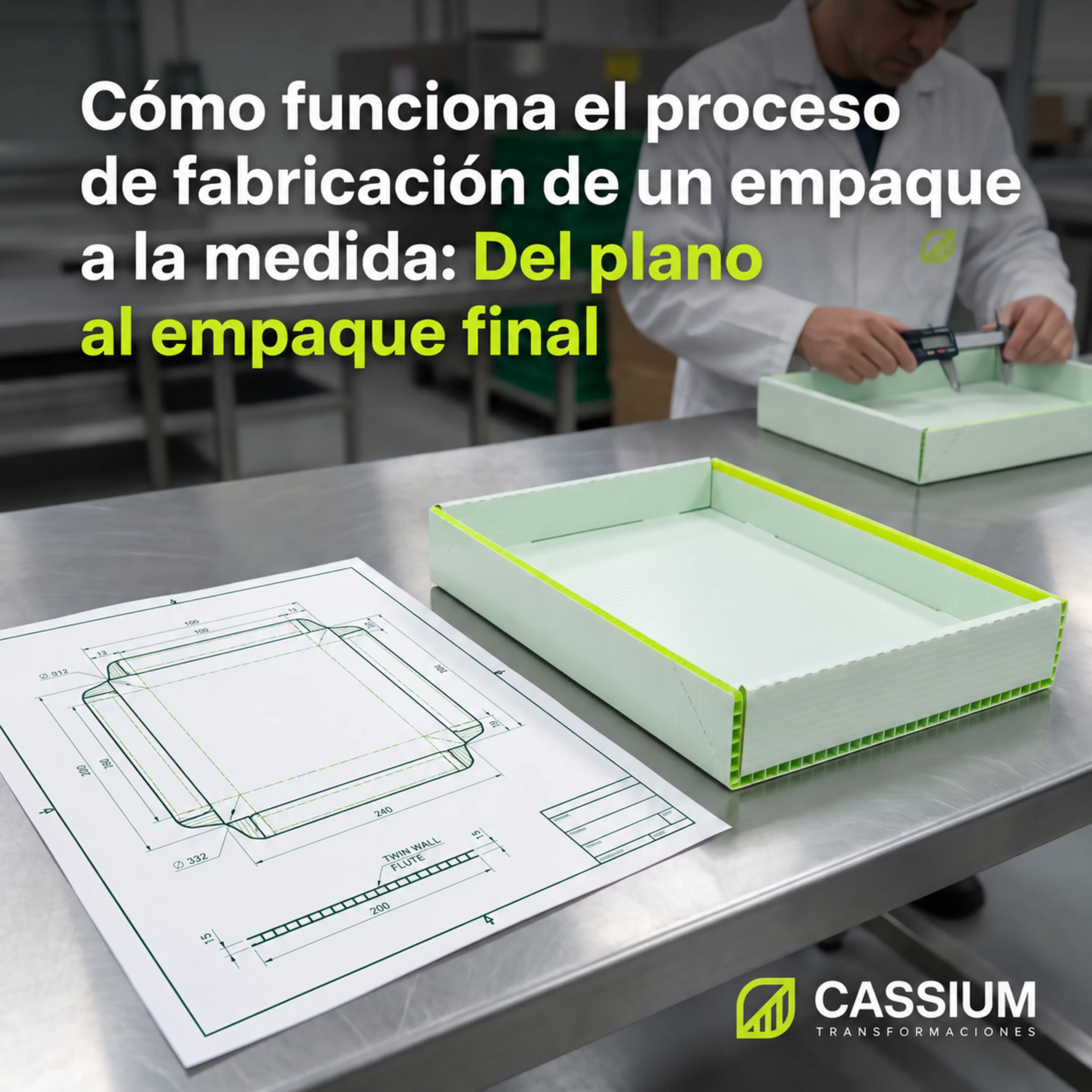
Manufacturing custom packaging runs from engineering design to quality validation, passing through cutting, folding, assembly, and finishing, in an integrated flow that at Cassium Transformaciones we control end to end without relying on third parties.
The Packaging Project That Stalls Before It Starts
Most delays in a custom packaging project don't happen during the first production run. They happen earlier, at the stage where the buyer hands over an operational need (protect a component, cut a cost per cycle, meet a requirement from an automotive or pharmaceutical customer) and the supplier translates it into an engineering drawing. If that translation happens without technical feedback from the buyer, the design moves forward on assumptions and the error only surfaces when the prototype reaches the plant.
Drawing Engineering: Where It's Decided Whether the Packaging Will Work on Your Line
At Cassium Transformaciones we start from the real dimensions of the component or product your operation moves, the space available on your material handling line, and the number of cycles you expect the packaging to withstand. With that information we develop the technical drawing and, when the project calls for it, a functional prototype before committing to a full production run. This stage determines whether your returnable packaging fits your racking, whether the loaded weight works with your forklift, and whether the wall design survives repeated handling without deforming. Validating the drawing before cutting avoids the most expensive scenario: discovering the incompatibility after the entire batch has already been manufactured.
When the project involves a critical component, such as an automotive part moving between supplier and assembler or a pharmaceutical product that must reach the packing line intact, this stage also sets the design's safety margin. Sizing a dunnage divider for a rigid component is not the same as sizing one for a component with scuff-sensitive surfaces. The more specific the information your engineering or quality team shares up front, the closer the drawing matches your real operation and the lower the chance the prototype needs a second round.
Cutting and Assembly: The Stage That Decides Whether Your Box Survives Cycle Forty or Breaks on the Third
Once the drawing is approved, the corrugated sheet enters a precision cutting and folding process. This is where a miscalculated tolerance, a worn die, or inconsistent folding turns a correct design into packaging that fails before completing its planned service life. For a buyer running a closed loop, this stage determines whether the returnable packaging delivers its forty uses or starts failing well before that, forcing packaging inventory to be replaced more often than budgeted.
Precision Cutting, Folding, and Ultrasonic Bonding
The sheet is cut with dies calibrated to hold consistent tolerances batch after batch, so a box from the tenth production run doesn't fit differently than a box from the first. At joints that demand greater structural strength, such as reinforced tray corners or dividers that carry weight on every cycle, we use ultrasonic bonding, which seals the material without adhesives or extra staples that can work loose under repeated handling. The result is packaging that holds its geometry and structural integrity for the number of cycles it was designed for, instead of degrading unpredictably.
For your operation this translates into a concrete figure: the number of cycles per box you can use in your total cost calculation against disposable packaging. If the assembly isn't consistent batch after batch, that figure stops being reliable and your finance team ends up budgeting savings the plant never realizes. Documenting the cutting and assembly process as part of the project gives you a number you can build a return on investment around, rather than an optimistic supplier estimate.
The Finish Your Quality Audit Can Reject on the First Batch
Technically functional packaging can still fall out of spec if the finish doesn't meet the requirement of the industry using it. A sensitive electronic component needs electrostatic discharge control. Packaging that circulates between plants within the same group needs corporate color and legible printing so the operator can identify the contents without opening the box. Packaging exposed to constant handling needs a UV treatment that survives daily use without fading or losing rigidity.
Printing, Corporate Color, UV, and ESD Control as Variants of the Same Process
These variants are part of the same manufacturing process at Cassium Transformaciones and are adjusted to the buyer's sector. For batteries and electronics we integrate ESD-controlled materials and coatings that reduce the risk of discharge onto sensitive components. For automotive and manufacturing we apply printing and corporate color that make visual traceability easier on the line. For operations with prolonged light exposure or intensive handling we apply UV treatment that extends the material's service life. Defining these variants at the drawing engineering stage keeps an entire batch from being rejected at your customer's receiving audit.
When these variants are specified from the start, your quality team can anticipate the acceptance criteria it will audit the batch against, instead of discovering them the moment the material arrives at the plant. That reduces the risk of a full delivery sitting on hold in receiving while a nonconformity gets resolved that the drawing could have prevented.
Forty Uses or Zero Return on Investment
The economic case for returnable packaging depends entirely on it actually completing the use cycles it was designed for. Packaging manufactured without documented quality control can look just as sturdy on the first visual inspection and still fail before reaching half its projected service life, erasing the savings that justified the project against disposable packaging.
ISO 9001:2015 Validation: Where the Packaging's Real Service Life Gets Confirmed
Our plant in Monterrey operates under an ISO 9001:2015 quality management system, which means every stage of the process, from receiving the corrugated sheet to the finished packaging, is documented and traceable. Before releasing a batch we verify that the material, the cut, the assembly, and the finish meet the specification approved in the original drawing, so the packaging that reaches your plant is in condition to complete up to forty use cycles without compromising its structural function. This validation is what turns the commercial promise of returnable packaging into a number you can confidently plug into your cost-per-cycle analysis.
For your operation, this means the manufacturing process doesn't end when the packaging leaves our plant in Monterrey. Our goal is for the packaging to keep doing its job through the fortieth cycle that backs the project's economic analysis, and that if at some point you need to adjust the design because your product or your line changed, you can go back to the same drawing engineering that produced the original packaging instead of starting over with another supplier.