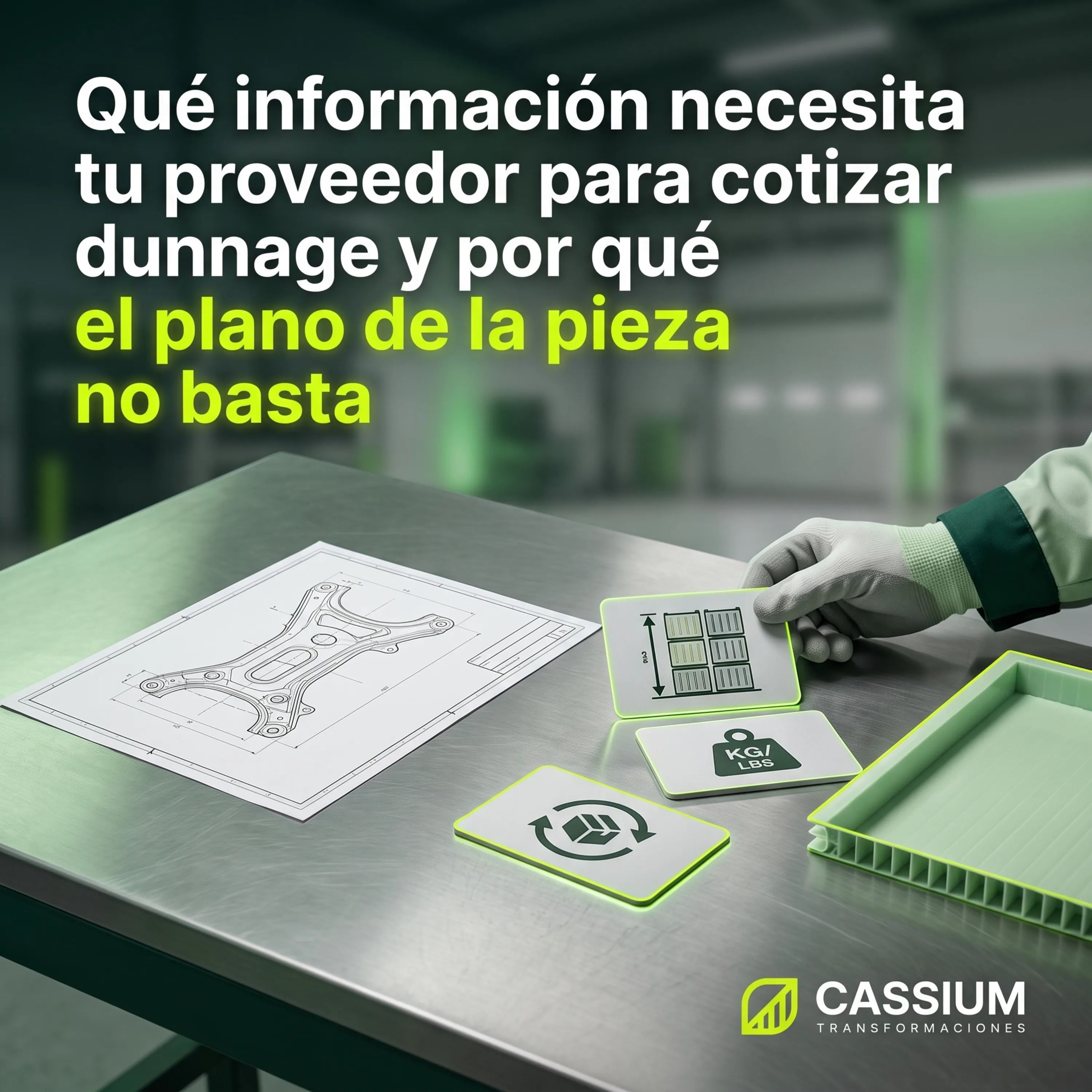
At Cassium Transformaciones we quote your custom dunnage in a single round of complete information: part geometry, handling, use cycles, and special requirements. The drawing on its own doesn't include any of that.
Why a Dunnage Quote Stalls Even When the Drawing Is Complete
A manufacturing drawing describes the part you need to protect: its dimensions, its tolerances, its critical points. What it doesn't describe is how that part moves through your operation, and that movement defines the dunnage separator's geometry. Two parts with identical drawings can need completely different dunnage if one is handled by a robot and the other manually, or if one travels in a stackable container and the other on a flat tray. When the supplier receives only the drawing, it has to guess at these variables or come back to ask, and every round of questions adds days to a quoting cycle that was already racing your start date.
Part Geometry Versus Container Geometry: The Variable the Drawing Doesn't Show
A dunnage separator doesn't protect the part in isolation, it protects it inside a specific container, with a set number of parts per level and a defined stacking pattern. To calculate that geometry we need the part model, the container it will travel in, and the number of parts per container your operation expects to handle. Without that data, any initial quote is an approximation that will likely change once the supplier finally receives the complete information, and that change almost always means an upward adjustment in price or lead time.
The Data Point That Delays the Most Dunnage Projects: The Real Handling Cycle
Your line's handling cycle, not just the part's geometry, determines how the dunnage separator has to behave. A separator a robot picks up by suction needs flat, obstruction-free surfaces where the gripper can grab without interference. A separator an operator handles manually needs a different kind of grip, with edges that pose no cut risk and a weight a person can lift every cycle without excessive fatigue. When this information doesn't arrive with the first request, the supplier quotes on an assumption that may turn out to be wrong, and the correction only surfaces once a sample has already been made that doesn't work on your line.
Manual, Robotic, or Conveyor Handling: Each One Demands a Different Separator
At Cassium Transformaciones we ask for your line's handling type from the very first quote request, because this variable changes the separator's design before any other parameter gets calculated. A separator for a conveyor needs lateral stability so it doesn't shift with equipment vibration. A separator for robotic handling needs consistent reference points your line's vision system can locate every cycle. A separator for manual handling puts ergonomics ahead of automation. Confirming this up front keeps your team from receiving a sample that matches the part's geometry but doesn't fit the equipment that will actually move it.
When This Data Is Missing, the Dunnage Separator Fails in the First Week of Production
The part's weight and the number of cycles you expect from the separator rarely appear on a manufacturing drawing, yet they directly determine the corrugated board caliper and the type of joint the dunnage needs. A separator sized for light parts that later receives heavier ones deforms before completing the cycles your closed-loop operation needs. This failure almost never shows up in the first delivery; it shows up after several weeks of use, once you've already built the separator into your process and a redesign means halting the flow while you wait for a replacement.
Weight, Stacking, and Number of Uses: The Math Behind 40-Cycle Durability
We design every dunnage separator to withstand up to 40 uses, but that number depends on three variables you have to confirm for us: the real weight of the loaded part, the stacking height during transport, and the number of cycles your closed loop will demand before replacement. With those three data points we calculate the corrugated sheet caliper and determine whether the critical joints need ultrasonic welding instead of folding alone. Confirming these parameters in the initial request lets us give you a firm quote, rather than a preliminary price that will move once the separator reaches your line and doesn't hold up under real use.
Why ESD, Color, or Visual Identification Change the Final Quote
A dunnage separator isn't always a neutral piece of corrugated board. When it protects electronic components or batteries, it needs static discharge control. When your operation handles several part families on the same line, color coding keeps an operator from placing the wrong part in the wrong separator. These requirements change the material, the surface treatment, or the printing process, and each carries a different cost and manufacturing time than standard dunnage. If this information gets added after the first quote arrives, the supplier has to recalculate starting from the material, which restarts the quoting cycle you had already been waiting weeks on.
Special Requirements: ESD and Color Coding in a Closed Loop
ESD shielding on a dunnage separator requires a specific treatment of the corrugated sheet that changes its electrical behavior without affecting its structural strength. Color coding is handled with direct printing on the corrugated board, defined together with your quality team so it matches the identification system you already use in the plant. Both requirements are compatible with the same base process of cutting, folding, and ultrasonic bonding we use across the rest of our catalog, as long as we define them from the first quote request and not as a last-minute change.
The Checklist That Cuts Weeks of Back-and-Forth From Your Quote
Most dunnage quotes drag on because the information arrives in fragments: one call clarifies a data point, an email clarifies another, and the supplier assembles the full picture weeks later. When you deliver the complete information in the first request, part and container geometry, handling type, weight, number of cycles, and special requirements, the supplier can calculate a firm quote from the very first exchange, with no additional rounds of questions. For the most technical product in your packaging catalog, that difference translates directly into calendar weeks you recover before your project even starts.
What to Send in the First Request to Get a Firm Quote
To quote your dunnage in a single round, at Cassium Transformaciones we ask for six data points from first contact: the part drawing or model, the real weight of the loaded part, the container it will travel in, your line's handling type, the number of cycles you expect from the separator, and any special ESD, UV, or corporate color requirement. With those six data points we calculate the sheet caliper, the separator geometry, and the joint type in the same review, and we hand you a quote that won't move once the project advances to production.