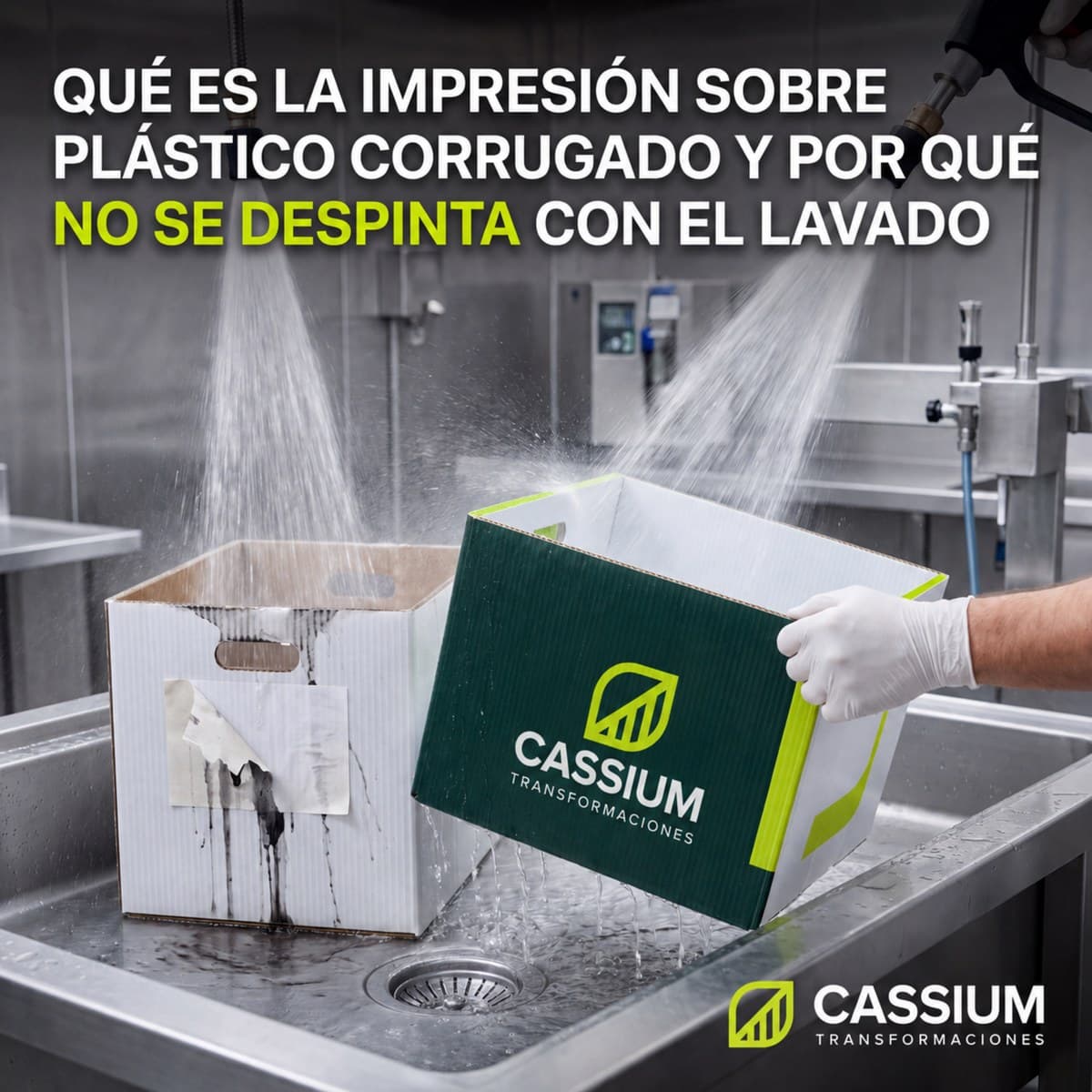
Printing on corrugated plastic uses inks and processes specifically designed to bond with the surface of the polypropylene, withstanding the same industrial wash cycle and sanitization chemicals as the container itself, unlike an adhesive label or a marker applied after the packaging is already made.
Why a Label or a Marker Doesn't Withstand Industrial Washing
Anyone coming from working with cardboard reasonably assumes, based on their own experience, that any mark or label will deteriorate with repeated use. That assumption is correct for cardboard, but it doesn't apply the same way to corrugated plastic.
Adhesive Labels Peel Off Under the Heat and Moisture of Washing
An adhesive label depends on glue that holds up under normal handling conditions, but rarely survives the heat and moisture of a repeated industrial wash cycle. After a few cycles, the label partially or fully peels off, leaving the container with no visible identification.
Permanent Marker Isn't Permanent Against Industrial Detergent
Permanent marker withstands normal handling and some ambient moisture, but it isn't built to withstand industrial detergent and the friction of pressure washing. After just a few cycles, the mark smears or disappears completely, forcing it to be rewritten again and again.
How Direct Printing on Corrugated Plastic Works
Printing on corrugated plastic works in a completely different way from gluing or writing something onto an already-manufactured container.
The Ink Bonds to the Polypropylene Surface, It Doesn't Just Sit on Top
The printing process for corrugated plastic uses inks specifically formulated to bond with the surface of the polypropylene, rather than just sitting on top of it the way a marker or a label would. That bond is what lets it withstand the same washing and the same sanitization chemicals as the container itself.
The Printing Process Happens as Part of Manufacturing the Container
At Cassium Transformaciones, printing is applied as part of the container's transformation process, not as a separate step after the packaging is already in use. That integration is what guarantees the printing withstands exactly the same washing and handling conditions as the rest of the container.
What Printed Identification Is For in a Closed Loop
Printed identification serves a concrete operational function within a closed-loop returnable packaging system.
Tracking Containers by Line, Customer, or Destination Without a Separate Label
With identification printed directly on the container, your team can track which production line, customer, or destination each piece belongs to without depending on a label that can get lost, peel off, or be confused with another container's.
Reducing Container Loss Within the Closed Loop
One of the most common risks in a closed-loop returnable packaging system is losing containers between the customer's facilities and the supplier's, because no one can confirm with certainty who each piece belongs to. Printed identification reduces that risk by keeping the information visible and legible throughout the container's entire service life, not just its first few cycles. Every container lost in the loop represents an investment that never returns to your returnable inventory, on top of the cost of manufacturing a replacement piece.
What to Consider Before Requesting Printing on Your Returnable Packaging
Before requesting printing on your next returnable packaging order, there are two decisions worth defining clearly.
Define What Information You Need to Identify: Customer, Line, Manufacturing Date
Decide what information you need the printing to communicate: customer name, production line number, container manufacturing date, or a combination of several of these. That decision determines the print design that gets integrated into the manufacturing process.
Confirm How Many Wash Cycles the Printing Will Withstand for Your Specific Application
The exact durability of the printing can vary depending on the type of detergent, wash temperature, and frequency of use in your specific application. Confirm with your supplier what evidence they have on the printing's performance under conditions similar to yours before finalizing the design.
What Happens When Identification Fails in a Real Closed Loop
When a container's identification stops being legible partway through its service life, the cost isn't limited to replacing a label.
Containers That Get Lost Between Facilities With No Clear Identification
A container with no legible identification is indistinguishable from any other generic container in the loop, making it easy for it to end up at the wrong facility or get lost entirely between your processes and your customer's.
Your Team's Time Spent Resolving Avoidable Confusion
Every time a supervisor has to stop to confirm who an unmarked container belongs to, that time is taken away from tasks that actually add value to the operation. Multiplied across weeks of an active closed loop, that lost time represents a constant, avoidable operational burden.
At Cassium Transformaciones we manufacture containers, trays, and separators with printing integrated into the transformation process, built to withstand the same industrial wash cycle as the rest of the piece. If your closed loop still depends on labels or markers that don't survive washing, we can go over with you what your application needs.