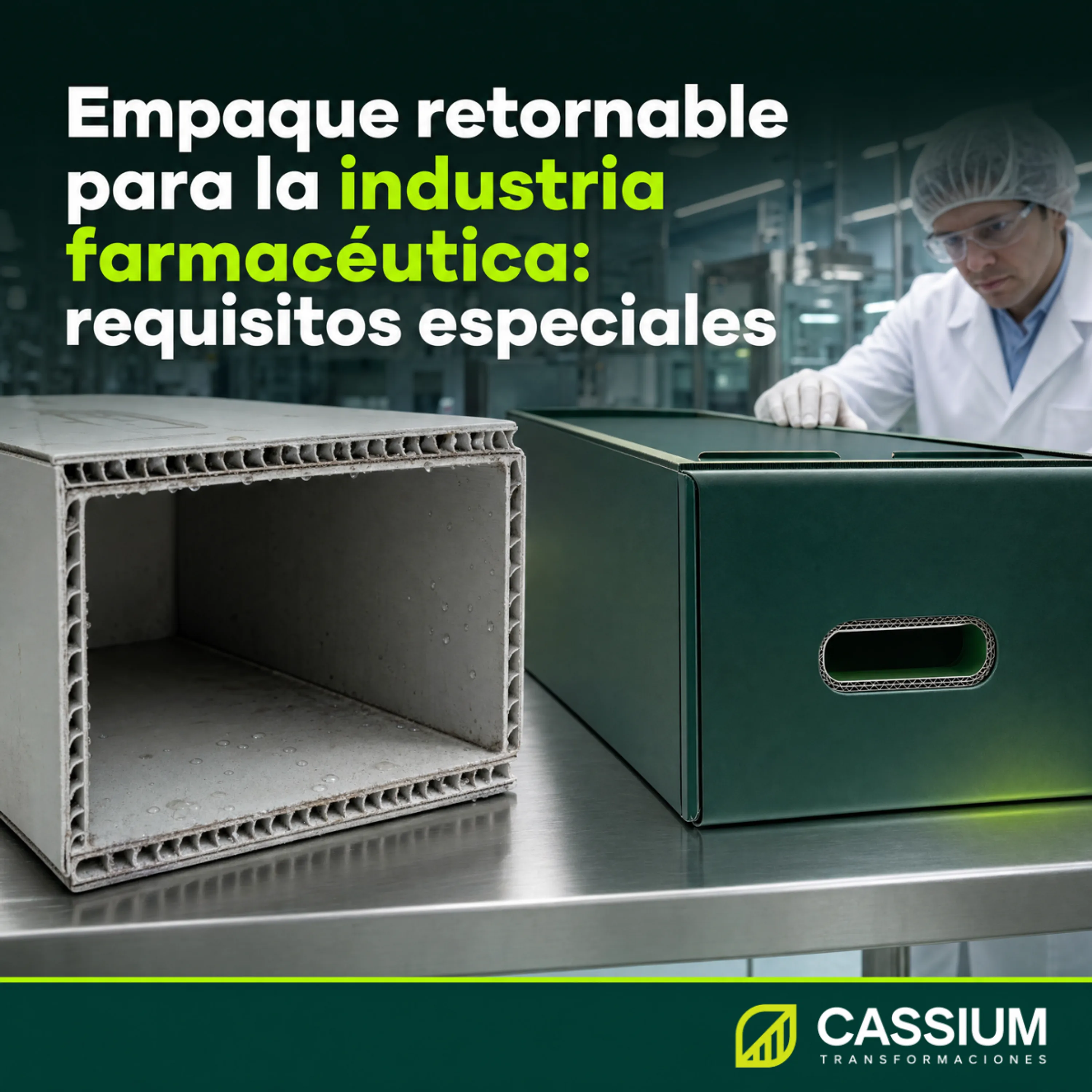
Pharmaceutical returnable packaging must be cleanable in a verifiable way, shed no particles, identify its area and its use, and be documented like any other process material. Your quality department defines those requirements before manufacturing.
Why packaging goes into the file even though it never touches the drug
In a pharmaceutical plant, Good Manufacturing Practices (GMP) reach everything that enters a controlled area, and returnable packaging enters several: the raw materials and components warehouse, the supply to production, the packaging area and the finished goods warehouse. Most of these containers never touch the drug directly, because they move closed bottles, blisters inside their folding carton, caps, labels or primary packaging components. Even so, the auditor evaluates them against the same three criteria applied to any object in the area: that it poses no risk of contamination, that it can be cleaned demonstrably and that its identification leaves no room for confusion.
The GMP principle: everything in the area must be explainable
GMP starts from a simple idea: product quality is demonstrated with records. Every object that coexists with the process has a procedure that says how it is used, how it is cleaned, who cleans it and where the evidence is kept. A returnable container that circulates without that procedure is a gap in the system, and the auditor treats it as such even if the container looks spotless. The problem appears when packaging is purchased as a logistics supply and never goes through the quality department before entering the plant.
Cardboard in a controlled area: fiber, moisture and pests
Cardboard is the first casualty of that analysis. It sheds fiber at the edges with every handling, absorbs moisture from the environment and from washing, and its flutes are a well-known refuge for insects. That is why a laboratory's internal procedures commonly restrict cardboard from passing into production areas, and the product is transferred to washable containers in an airlock or a transfer area. Corrugated polypropylene returnable packaging solves that transfer at the source: the same container can enter, be cleaned and circulate again, with a procedure to back it up.
Where an ordinary returnable fails when it enters a regulated area
Replacing cardboard with corrugated plastic is the first step, and the easiest one. A polypropylene container designed for automotive or general logistics can fail a pharmaceutical audit over details nobody checks in those industries.
Open flutes: where water and dust hide
Corrugated sheet has internal flutes that run from one end to the other. On a cut edge, those flutes remain open like small tubes that take in water during washing and dust during use, and that a cloth never reaches. That is the exact spot the auditor checks when turning a box over. For pharmaceutical use, the design solves the edges from the drawing: they are folded inward, sealed ultrasonically in the zones where the geometry allows it, or oriented so water drains and the flute stays visible during inspection. Each option has a cost and an application, and it pays to decide it with your quality department before manufacturing the fleet.
Staples, adhesives and tapes: three sources of particles
Many industrial containers are assembled with metal staples, adhesive or tape. All three options are a risk in a pharmaceutical area: a staple can come loose and become a metallic foreign body, adhesive degrades with washing and with sanitizing agents, and tape collects dirt at the edge and peels off in fragments. At Cassium Transformaciones we join high-stress pieces with ultrasonic welding, which melts the polypropylene itself along the joint line and leaves a single-material piece, with no added elements to inspect or replace.
A surface that can be cleaned and verified
Polypropylene does not absorb water, and its smooth surface lets you see at a glance whether any residue remained after cleaning. That property loses value if the design adds corners the cloth cannot reach: cells that are too narrow, closed inside corners or fixed partitions that block access. In a container for pharmaceuticals, every interior surface must be within reach of the cleaning method your plant uses, whether washing, manual cleaning or spray sanitization. The material's compatibility with your cleaning and sanitizing agents is confirmed with a sample in your own process, because each laboratory uses different products and concentrations.
When an unidentified box mixes an approved lot with one in quarantine
In pharmaceuticals, the status of a material (quarantined, approved or rejected) determines where it can move, and a status mix-up is among the most serious deviations a warehouse can record. The returnable container takes part in that control even though the status is defined by the lot label, because it is the object the operator sees, moves and places. A fleet of identical boxes with no identification of their own multiplies the probability of error in every movement.
Color and printing by area and by use
Sheet color and printing make it possible to dedicate containers to a specific area or use: one color for the materials warehouse, another for supply to production, another for finished goods. That way, a container outside its area is spotted from a distance, before someone uses it where it does not belong. We manufacture the sheet in the color your system defines and apply printing that withstands repeated washing, so the legend and the assigned area stay legible throughout the container's life.
Serial number and cleaning record per container
The second layer is a code or sequential number printed on the container. With it, your team can record every cleaning, every instance of damage and every withdrawal per piece, and answer in an audit the question left unanswered in the opening scenario: when that box was last washed and who did it. The same record serves to retire containers at the end of their service life with a documented criterion, rather than waiting for a damaged edge to show up in an inspection.
Traceability of the packaging's own material
The auditor may also ask where the container came from. We extrude the sheet at our Monterrey plant and convert it in the same place, under an ISO 9001 certified quality management system, which allows us to link each order to the sheet lot it was made from. For a regulated process, that short chain between the resin and the finished product has added value: any change in the material or the process goes through a single manufacturer, and that manufacturer can give you notice before it reaches your plant. Change control is a central GMP concept, and your packaging supplier should handle it with the same seriousness.
What to validate with your quality department before approving the fleet
The requirements for pharmaceutical packaging depend on the product, the area and the market, and your quality department has the final word. These are the definitions worth settling with them before requesting a quote, because each one changes the design:
- The exact use: whether the container carries product in secondary packaging, primary packaging components or, in exceptional cases, material in direct contact. That last case requires a much stricter evaluation of the material against the regulations applicable to your product.
- The areas it will circulate through and the cleaning method for each one, with the agents and frequency your plant already uses.
- The identification system: color by area, legends, code or serial number, and on which faces of the container it must be visible.
- The need for antistatic sheet, if the container shares space with equipment or devices that contain electronics.
- The documentation your quality department will request to approve the supplier: material data sheet, quality system certificate and approved drawing with revision number.
The sample and the prototype as part of supplier qualification
A laboratory tests new packaging before approving it. It requests a sample to run through its cleaning procedure, checks how the material behaves with its sanitizing agents and verifies that the design leaves no inaccessible zones. That is why we deliver a prototype with the real product or part before producing the fleet, and we adjust the design based on your quality department's observations. That cycle of testing and adjustment costs a few weeks at the start and prevents a finding that costs much more halfway through the year.
At Cassium Transformaciones we manufacture returnable boxes, trays, dividers and containers for pharmaceuticals with sheet from our own extrusion, ultrasonic joints, color and printing for identification, and the antistatic variant when the process calls for it. We design around your product and your procedure, and we deliver the material documentation so your quality department can carry out its own evaluation.
If your returnable containers still circulate through the laboratory without a cleaning procedure, without their own identification or with open edges, the next audit will find them. At Cassium Transformaciones we design the packaging together with your quality department, with a prototype and material documentation before manufacturing the fleet. Tell us about your process at https://transformaciones.cassium.com.mx/en