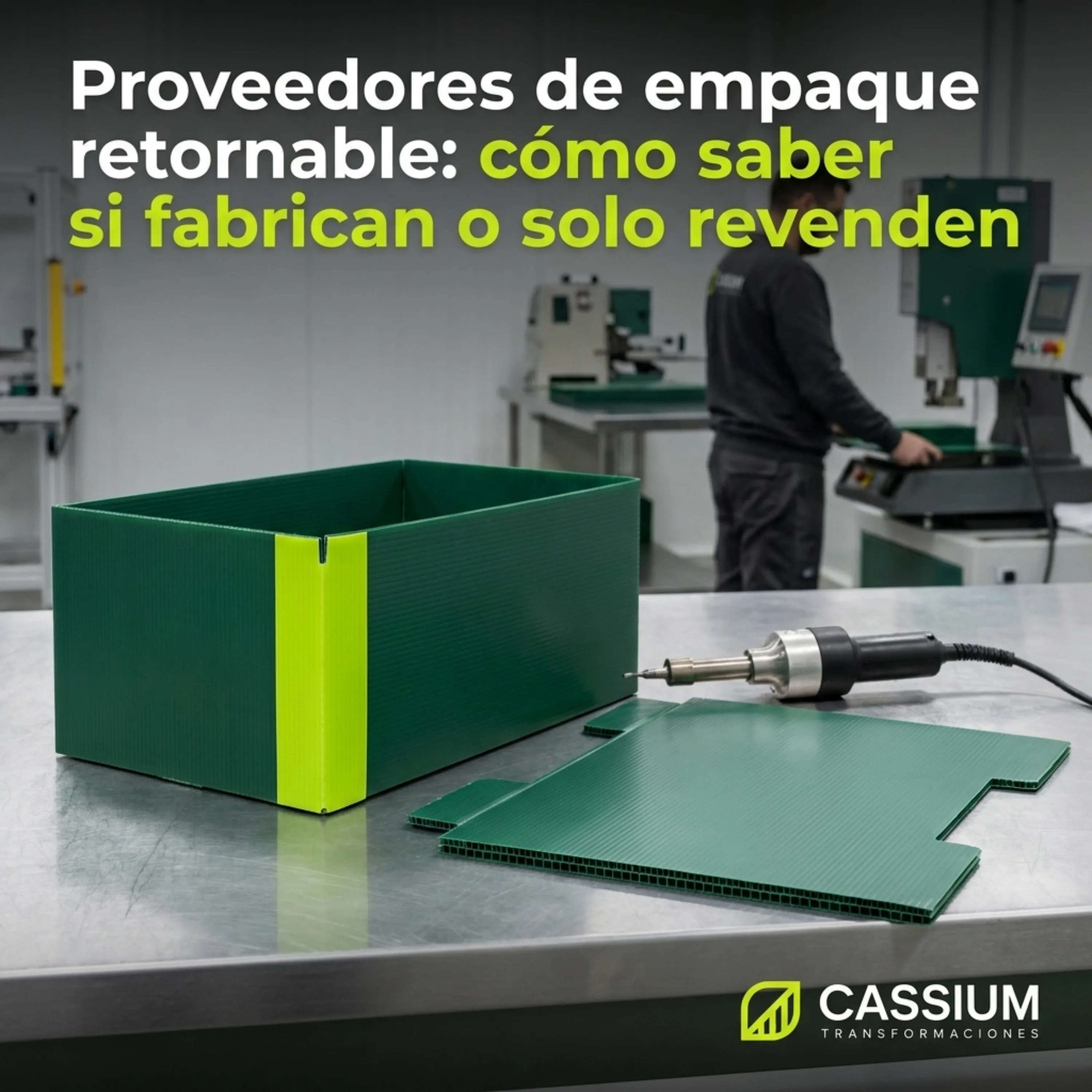
A real manufacturer controls the sheet, the cutting tooling, and the production schedule. A reseller depends on third parties on all three fronts. That difference becomes visible the day you need a replacement or a redesign.
The Day You Need a Replacement Is the Day You Find Out Who Manufactures
While the operation runs smoothly, the difference between a manufacturer and a reseller stays invisible. The boxes arrive complete, the line packs, the container ships out, comes back, and gets loaded again. The system works, and nobody at the plant cares where the sheet came from or who folded the walls. The distinction shows up all at once in three very specific moments: when a batch of containers gets damaged, when your customer changes the part geometry and the divider no longer fits, and when you open a second route and need forty additional containers by the following Monday.
In any of those moments your supplier has two options. If it manufactures, it reshuffles its own extrusion and cutting schedule and answers with a date that depends on its own plant. If it resells, it gets in line behind someone else, with a date and a minimum order quantity it doesn't control. The answer you get on that call is worth more than any sales presentation.
The Three-Link Chain That Turns a Replacement Into Eight Weeks
Behind a corrugated plastic box bought from a middleman there are usually three separate companies. An extruder produces the sheet and works in campaigns: it runs a given color and caliper once it has gathered enough volume, not when you need it. A converting shop cuts, folds, and seals the finished product, and schedules its table around the orders it had already committed to. At the end of the chain, the distributor that sold you the box adds its own administrative time, its logistics, and its margin.
Every link carries a minimum lead time and a minimum order quantity. Added up, they explain why replacing forty boxes can turn into eight weeks without anyone acting in bad faith. Your urgency simply enters at the back of a queue your supplier doesn't manage. The operational implication is direct: the response time promised in the quote is only real as long as nothing strays from the original plan.
Sheet Caliper: The Variable a Middleman Can't Move
Returnable packaging behaves according to the caliper, the resin, and the additives of the sheet it's made from. The same box design, built from a lighter sheet, loses rigidity at the bottom corner and starts failing well before completing its projected service life. A supplier that extrudes its own sheet adjusts the weight for your application, adds ultraviolet protection if the container will sit waiting in a yard, builds in dissipative additives when you're moving sensitive electronic components, and produces the corporate color your customer asks for to identify its fleet.
A reseller works with whatever is in its supplier's catalog. When your part needs a firmer wall or a specific treatment, the only available answer is the standard caliper, with the hope that it holds. That limitation doesn't show up in the first delivery. It shows up at cycle twenty, when the fleet starts degrading ahead of schedule and cost per use spikes because the box never reached the number of uses that justified the investment.
The Signs That Separate an In-House Plant From a Borrowed Catalog
None of these signs requires advanced technical knowledge or a formal audit. All of them can be verified on a visit, on a call, or by carefully reading a document your supplier should already have on hand.
The Plant Visit: What You Have to Be Able to See That Same Day
A manufacturer opens the door fairly readily, because the plant is its best sales argument. There you should be able to see the extrusion line running, rolls and sheets of material identified by lot, the cutting table with the tooling mounted, the presses or folding stations, the ultrasonic welding equipment, and the printing area. You should also see other customers' work in process, with geometries different from yours.
The opposite sign is just as clear. When the visit gets postponed for weeks, when the address turns out to be a warehouse with finished goods and shelving, or when the tour is limited to a meeting room with samples on the table, you already have your answer. An honest middleman will say so up front; the problem is the one who presents a third party's plant as its own.
The Scope of the Certificate and the Name That Appears on It
Many suppliers mention a quality certification in their pitch. It pays to ask for the document and read two fields. The first is the legal entity: the certificate has to be issued to the company you're going to sign with, not to a partner or to a supplier somewhere in the chain. The second is the scope, which describes what activity was actually certified. A scope that mentions design and manufacture of corrugated plastic packaging says something very different from one that mentions sales and distribution.
At our Monterrey plant we operate under a quality management system certified to ISO 9001:2015, and the scope covers the conversion of the finished product we deliver. That detail matters when your quality team has to document packaging traceability for a customer audit. If the certificate belongs to another company, traceability breaks at exactly the link you most need to hold.
The Redesign Test: Ask for a Change and Measure the Response
This is the fastest test of them all. Ask for a small, concrete modification to a part that has already been quoted: move a divider fifteen millimeters, raise the wall by two centimeters, add a side inspection window, change the orientation of the cells. Then watch what kind of response you get.
A manufacturer turns that change into a physical sample within days, because it has the drawing, the cutting, and the folding station inside the same building. A reseller responds with a long lead time, a tooling cost that belongs to a third party, and, often, a recommendation that you settle for the original design. That difference is the same one you'll live through every time your customer changes a part, and in a closed loop your parts change more often than the initial project assumes.
Why Integrating Sheet and Finished Product Changes Your Cost per Cycle
The economic case for returnable packaging rests on a single variable: how many uses each container completes before leaving the fleet. Everything that happens upstream of your plant influences that number, and that's where integration stops being an org-chart detail and becomes a financial figure.
In-House Extrusion: Control Over Weight, Additives, and Corporate Color
At Cassium Transformaciones we extrude the corrugated polypropylene sheet we later convert. That lets us set the caliper according to your part's mass and the handling it will receive, add ultraviolet protection for containers that spend hours in a yard, offer dissipative variants for electronics and battery lines, and produce the corporate color your customer uses to identify its fleet without depending on a third party's availability. Our boxes are designed to reach up to forty uses, and that number only holds when the starting material matches the application.
The commercial consequence is simple to calculate. If your container completes forty cycles, the cost per trip is spread across forty trips. If the material gives way at cycle fifteen because of an insufficient caliper, that same container costs nearly three times more per trip and the business case you presented to management stops closing.
Cutting, Folding, Ultrasonic Bonding, and Printing Under One Roof
Custom packaging accumulates tolerances at every process step. Cutting defines the geometry, folding defines the squareness, ultrasonic bonding defines the strength of the joint, and printing defines the identification that lets you track the container through the chain. When those four processes happen at different plants, each tolerance gets negotiated separately and the accumulated error shows up at your dock, inside a box that no longer closes properly.
By running all four processes in the same plant, we work with a single party accountable for the accumulated tolerance. For your operation that means one point of contact when something drifts, a drawing that gets corrected once, and a replacement batch that comes out identical to the original, even if two years went by between them.
The File Worth Requesting Before You Release the First Order
Before signing a returnable packaging contract, it's worth gathering six items. The exact address of the plant where it's manufactured, with a specific visit date. The complete quality certificate, with the legal entity and the scope legible. A physical sample of the quoted design, with your own part inside. The tooling drawing, which should exist and be identified. The replacement policy in writing, with a committed lead time for partial orders. And the sheet's technical data sheet, with caliper, resin, and additives declared.
A supplier that manufactures hands over all six without discomfort, because they all exist inside its own operation. A supplier that resells hands over two or three and explains the rest in generalities. That conversation takes half an hour and spares you the scenario this article opened with.
If you're evaluating suppliers for a closed-loop project in automotive, food, pharmaceutical, logistics, or electronics, start by asking where the extruder is. The answer orders the rest of the evaluation.