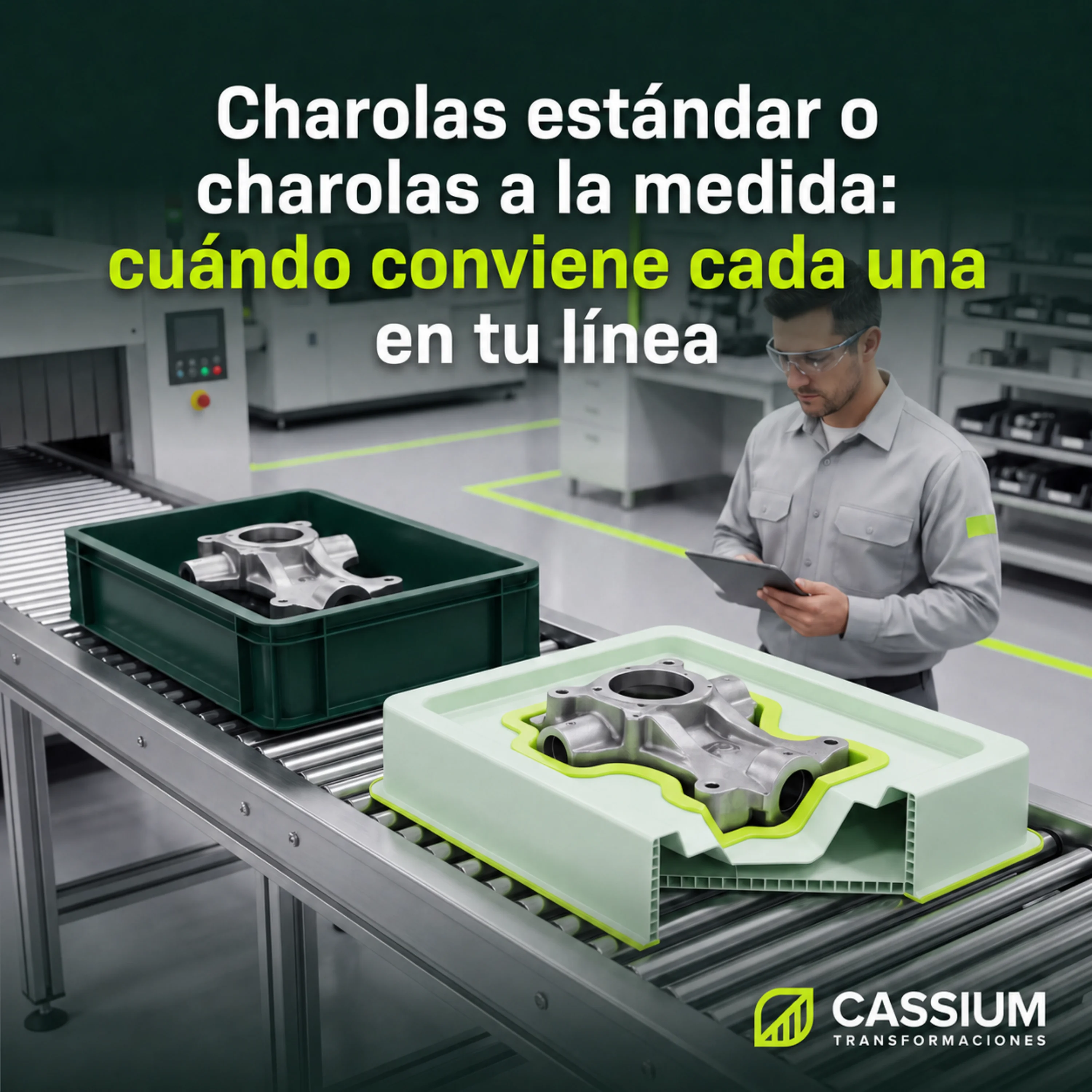
A standard tray cuts cost and lead time, but it only protects the part if its geometry matches the real design. When it doesn't, a custom tray solves the problem on your line.
The Hidden Risk of Deciding on Catalog Price Alone
In closed-loop operations across automotive, logistics, food, beverage, pharma, manufacturing, batteries, and electronics, the standard tray is the first option your purchasing team checks because the catalog already has the size, price, and lead time defined. That decision works well when the part you're protecting falls within a common dimension family and doesn't require any special finish. The problem shows up when your packaging engineering team doesn't validate the part's real geometry against the tray before authorizing the purchase, and your quality team discovers the mismatch weeks later, with the first batch already in production.
When you buy a tray on price alone without validating the real fit, the initial savings evaporate fast. Every part that shifts inside the tray during handling or transport multiplies the risk of surface damage, misalignment at the next station, and rework time nobody budgeted for. In a closed loop where the same tray can deliver up to forty use cycles, that mismatch doesn't fix itself: it repeats on every return trip.
This decision is rarely made by a single department. In automotive, pharma, or batteries, your packaging engineering team validates the geometry and handling, your quality team reviews the risk of damage and cross-contamination, and your logistics team confirms whether the tray survives the transport cycle between your plant and your customer. When any of the three departments skips the review before the purchase, the mismatch between tray and part doesn't surface until it's already hit production.
Excess Clearance: The Mechanism That Bangs the Part Around in Transit
The mechanism behind the damage is easy to name and expensive to ignore: excess clearance. A standard tray is designed to cover a range of sizes, not your part's exact geometry. That extra margin, which looks like flexibility in a catalog, translates on your line into free space where the part shifts every time the container moves, gets stacked, or changes conveyor. The corrugated sheet absorbs part of the impact, but only up to a point: once the free space exceeds what the material can compensate for, the wall stops cushioning and starts transmitting the impact straight to the part.
That shift knocks the part against the corrugated sheet wall on every movement. On a painted, chrome, or otherwise sensitive-finish part, the result is a scratch or mark that your quality team doesn't catch until final inspection, by which point you've already invested manufacturing time in a part that ends up rejected. In a closed loop, where the tray returns for reuse up to forty times, that same clearance keeps banging the part around on every cycle if nobody corrects the container's design.
The Point Where a Custom Tray Stops Being Optional on Your Line
For some parts, a custom tray becomes a requirement of your process, not a budget decision. Irregular geometries, parts with multiple support points, electronic components sensitive to electrostatic discharge, or parts with a finish that can only touch a surface designed specifically to hold them are the cases where a standard tray lacks the shape your part needs.
At Cassium Transformaciones we manufacture the custom tray from your own corrugated sheet, with the cutting, folding, and, when the design calls for it, ultrasonic bonding that defines the exact cavity where your part stays put. This applies regardless of the volume you run: a low-volume line with high-value parts has the same technical case for switching to a custom tray as a high-volume line with delicate parts.
ESD Compatibility and UV Finish: Variables the Catalog Doesn't Solve
The second mechanism the catalog doesn't cover is compatibility with the process your part goes through. If your operation handles electronic components or batteries, the tray needs ESD treatment to dissipate static charge before it damages the component. A generic container doesn't offer that variant because its design is built for general use.
The same applies if the tray is going to sit exposed to the weather in the yard or in transit between your plant and your customer: a UV finish keeps the corrugated sheet from losing structural strength under prolonged sun exposure, a spec a standard catalog tray doesn't account for. On top of that, corporate color as a service, which at Cassium Transformaciones we apply during the tray's printing so your team can identify the container and the process it belongs to at a glance, without relying on an extra label that can peel off or get dirty over forty use cycles.
The Real Criteria for Choosing Between Standard and Custom on Your Line
The decision comes down to three variables your packaging engineering team can validate before quoting: the value of the part you're protecting, the number of return cycles you plan to give that tray within your closed loop, and the part's real tolerance for contact and movement. When all three variables point to a low margin for error, a custom tray protects your investment in the part, not just the packaging around it.
This same criterion applies whether your operation is in battery manufacturing, electronic assembly, food and beverage packing, or pharmaceutical production: what decides it is how critical it is for that specific part to arrive without a single point of contact outside what was designed, regardless of the sector your plant operates in.
The standard requires the same documented quality control for every tray, standard or custom, that leaves our ISO 9001:2015-certified plant in Monterrey. What changes between the two is whether the tray's geometry, finish, and strength match exactly what your part needs throughout its service life inside the closed loop.
Cost Per Cycle: How Price Translates Into Real Protection Across 40 Uses
Comparing tray price against tray price with no further context is the most common calculation error in this decision. The metric that actually matters is cost per cycle of protection: divide the tray's price by the number of real uses you're going to give it inside your closed loop, then compare that result against the cost of every part rejected, reworked, or damaged in transit by a tray that didn't fit right.
A custom tray that protects your part through all forty full use cycles, without generating a single damage-related rejection, pays back its upfront cost faster than the quote makes it look. A standard tray that fails before cycle twenty because the part shifted too many times ends up costing more per unit protected, even though its list price was lower.
At Cassium Transformaciones we evaluate your part's geometry, the process it fits into, and the number of cycles you need before recommending a standard or custom tray. We manufacture both variants from our own corrugated sheet, with cutting, folding, ultrasonic bonding, printing, and the ESD, UV, or corporate color finishes your operation requires, from our ISO 9001:2015-certified plant in Monterrey. Whether your team works in packaging engineering, quality, or logistics, the goal is the same: the tray you choose holds the right part through every cycle your closed loop needs.